A Smarter Way to Scale Your Workforce
/
5min
/
Post by
Leticia Katz

Team Augmentation: How to Scale Your Team Strategically
Team Augmentation helps companies by adding skilled global talent to their internal teams. This happens when and where it is needed. Instead of outsourcing control or hiring long-term staff, businesses keep ownership of their work. This helps them gain the speed and flexibility they need to compete.
Scaling your team shouldn’t mean slowing your business down. Yet traditional hiring often creates delays, increases fixed costs, and limits flexibility—especially when you need specialized skills fast.
For organizations that want to grow, improve ROI, and excel in execution, team augmentation is now a key strategy.
What Is Team Augmentation?
At its core, team augmentation is a workforce strategy that allows companies to supplement their internal team with external professionals who possess specific skills or expertise. Team augmentation is different from full outsourcing. In full outsourcing, a project is given to an outside provider. With team augmentation, the company keeps control of the work. It adds skilled contributors to help the internal teams.
Augmented team members fit into your current workflows. They use your tools and follow your processes. They work under your project management guidance, usually for a set time or project phase.
When Is Team Augmentation the Right Strategy?
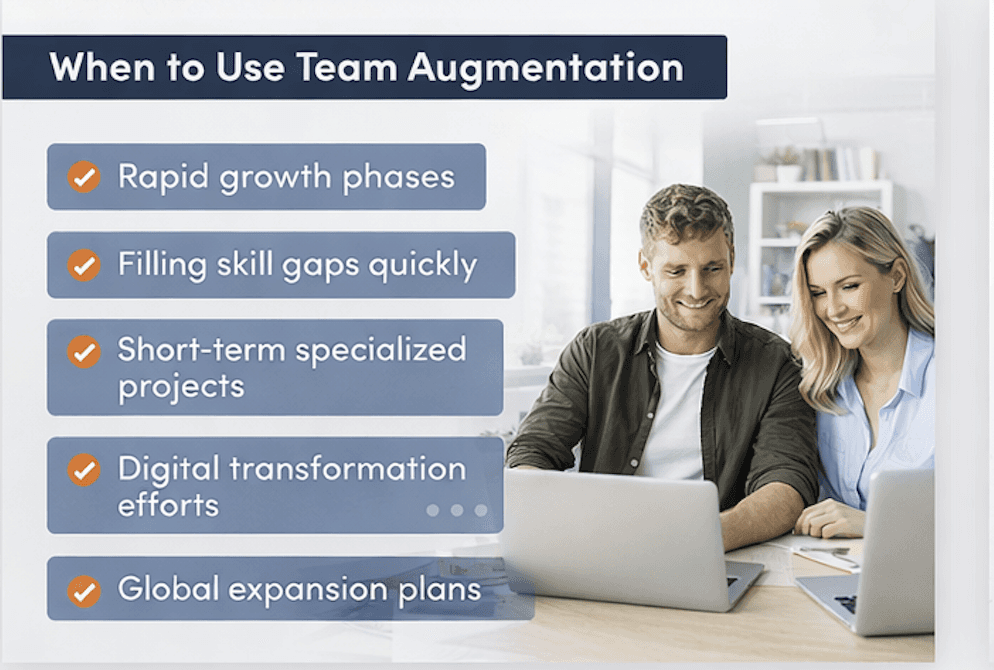
This engagement model proves especially effective when organizations require speed, flexibility, and rapid access to specialized skills to drive business outcomes. Common scenarios include:
Rapid growth or scaling phases, when hiring full-time employees would slow execution
Skill gaps within existing teams, especially for niche or senior expertise
Short- or mid-term initiatives where long-term headcount does not make financial sense
Digital transformation projects that require immediate technical capacity
Global expansion, when local talent is scarce or cost-prohibitive
In these situations, team augmentation enables companies to move forward without compromising quality, timelines, or internal focus.
Core Benefits of Team Augmentation
Team augmentation delivers value across multiple dimensions:
Faster Access to Talent
Companies bypass lengthy recruitment cycles and onboard skilled professionals in weeks rather than months.
Global Talent Pool
Augmentation opens access to specialists across geographies, helping you find rare skills that may not be locally available.
Cost Efficiency
Team augmentation usually costs less than hiring full-time employees. It can lower expenses like benefits, office space, and HR management.
Scalability and Flexibility
You can increase or decrease team size in response to project demands without long-term obligations.
Knowledge Transfer and Upskilling
Working with external specialists can bring fresh perspectives and elevate your internal team’s skills through collaboration.
Five Key Conditions for Effective Team Augmentation
To ensure that team augmentation delivers its full potential, there are five essential conditions every organization must address:
1. Clearly Defined Requirements
A successful augmentation initiative begins with precision in scope and expectations. Clearly specify the technical skills, deliverables, success metrics, and expected outcomes before onboarding external team members. Ambiguity at this stage leads to misaligned deliverables and wasted effort.
2. Comprehensive Screening Process
Not all talent fits every team culture or project need. A thoughtful screening process — evaluating both technical skill and cultural fit — minimizes risk and ensures the right match. This includes interviews, technical assessments, and alignment with your team’s working style.
3. Clear Communication
Establishing open, consistent communication channels helps prevent misunderstandings and ensures alignment on priorities and progress. Regular status updates, shared documentation, and integration into daily workflows are crucial.
4. Flexibility and Adaptability
Teams that succeed with augmentation are willing to adapt their processes and expectations. External contributors should be regarded as collaborative partners rather than isolated task performers. Flexibility around evolving requirements or working styles promotes better outcomes.
5. Performance Monitoring
Track performance through objective metrics and timely feedback. Monitoring helps identify issues early, maintain high-quality work, and support continuous improvement throughout the engagement.
What Happens When Key Conditions Are Missing?
Understanding what can go wrong reinforces why best practices matter:
Without clear requirements, teams waste time revisiting scope and priorities
Without proper vetting, productivity suffers, and rework increases
Without strong communication, small issues escalate into delivery risks
Without performance monitoring, quality and accountability decline
Successful team augmentation is not just about adding talent. It is also about creating the right environment for that talent to succeed.
Team Augmentation vs. Other Models: How It Differs
Rather than functioning like traditional outsourcing or staffing models, team augmentation integrates directly with internal teams.
Augmentation vs. Dedicated Teams:
A dedicated team often consists of a group fully managed by a vendor to deliver a complete solution. Augmentation integrates external professionals into your existing structure.
Augmentation vs. Project Outsourcing:
Outsourced projects place deliverables and management with a third party, while augmentation keeps control with your internal team.
How to Choose the Right Team Augmentation Partner
Achieving strong results depends on choosing the right partner. In addition to technical expertise, organizations should evaluate providers across several dimensions:
Talent quality and vetting rigor: Are candidates thoroughly screened for both technical expertise and communication skills?
Operational transparency: Do you maintain visibility into performance, workload, and progress?
Cultural and workflow alignment: Can augmented professionals integrate seamlessly into your tools, processes, and team dynamics?
Scalability and flexibility: Can the provider scale talent up or down as priorities evolve?
Business understanding: Does the partner understand your industry, growth goals, and ROI expectations?
A strong team augmentation partner acts as an extension of your organization—not just a talent supplier.
Common Team Augmentation Challenges (and How to Avoid Them)

While team augmentation offers significant advantages, it is not without risks if poorly executed. Common challenges include:
Misaligned expectations due to unclear role definitions
Communication breakdowns across distributed teams
Integration friction with internal workflows or culture
Inconsistent performance tracking
These risks are mitigated through structured onboarding, clear ownership, shared documentation, and ongoing performance management. When treated as a strategic engagement rather than a transactional one, team augmentation consistently delivers strong outcomes.
Team Augmentation Trends and Market Outlook
As businesses continue to prioritize agility and cost efficiency, team augmentation is increasingly becoming a core workforce strategy. The rise of remote work, global access to talent, and outcome-driven hiring models has accelerated adoption across industries.
Organizations are shifting away from rigid, location-bound hiring toward flexible team structures that scale with demand. In this context, team augmentation is not just a short-term fix. It is a long-term advantage for companies seeking to grow and remain strong.
Frequently Asked Questions About Team Augmentation
What is the difference between team augmentation and staff augmentation?
While often used interchangeably, team augmentation typically emphasizes deeper integration with internal teams and workflows, rather than simply filling individual roles.
Is it suitable for long-term projects?
Yes. Many companies use team augmentation for long-running initiatives, adjusting team size and skill sets as needs evolve.
Does it reduce costs?
Compared to full-time hiring, team augmentation often lowers fixed costs while improving access to specialized expertise.
Who manages augmented team members?
Management remains with the client. Augmented professionals work under your leadership, tools, and processes.
Conclusion
No longer just a hiring option, this model has become a core strategy for companies focused on growth. By enabling faster execution, greater flexibility, and sustained control over delivery, it supports teams as they scale.
With the right structure, communication, and performance oversight, organizations can grow their workforce efficiently. This approach avoids the cost, risk, and rigidity of traditional hiring.
The difference between success and frustration lies in execution. Set clear goals.
Choose the right talent carefully.
Ensure smooth integration.
Manage performance regularly.
These steps change team augmentation from a quick solution into a long-term advantage.
At Kajae, team augmentation is built around these principles. Kajae connects companies with top talent from around the world. This talent joins existing teams to help organizations grow confidently. Kajae drives impact, efficiency, and measurable returns on investment.
If your business needs to grow without slowing down, team augmentation may be the smartest next step.
Scale your team with confidence.
Talent that changes the game
You’ve built momentum. Now add the talent that helps you scale it.