Marketing Strategy: An In-Depth Guide Built for Real Business Growth
/
5min
/
Post by
Leticia Katz

Marketing strategy is often discussed, rarely defined, and even more seldom executed well. Most organizations invest heavily in tactics—content, ads, social media—without a clear strategic backbone. The result is activity without direction and effort without measurable impact.
High-performing marketing teams operate differently. They treat strategy as a decision-making system, not a planning document. Every campaign, channel, and message exists for a reason—and that reason is tied directly to business outcomes.
This guide breaks down what an effective marketing strategy looks like in practice, using real-world examples and lessons observed across high-growth companies.
What Marketing Strategy Actually Means
At its core, a marketing strategy defines how an organization creates demand and captures value. It clarifies who the audience is, what problem is being solved, and why the organization is uniquely positioned to solve it.
More importantly, strategy creates focus.
When Spotify entered markets dominated by Apple and Amazon, it did not attempt to compete on budget or scale. Instead, it leaned into personalization and data-driven storytelling. Initiatives like Spotify Wrapped were not isolated creative ideas—they were a direct outcome of a strategy centered on user behavior, emotional engagement, and organic distribution.
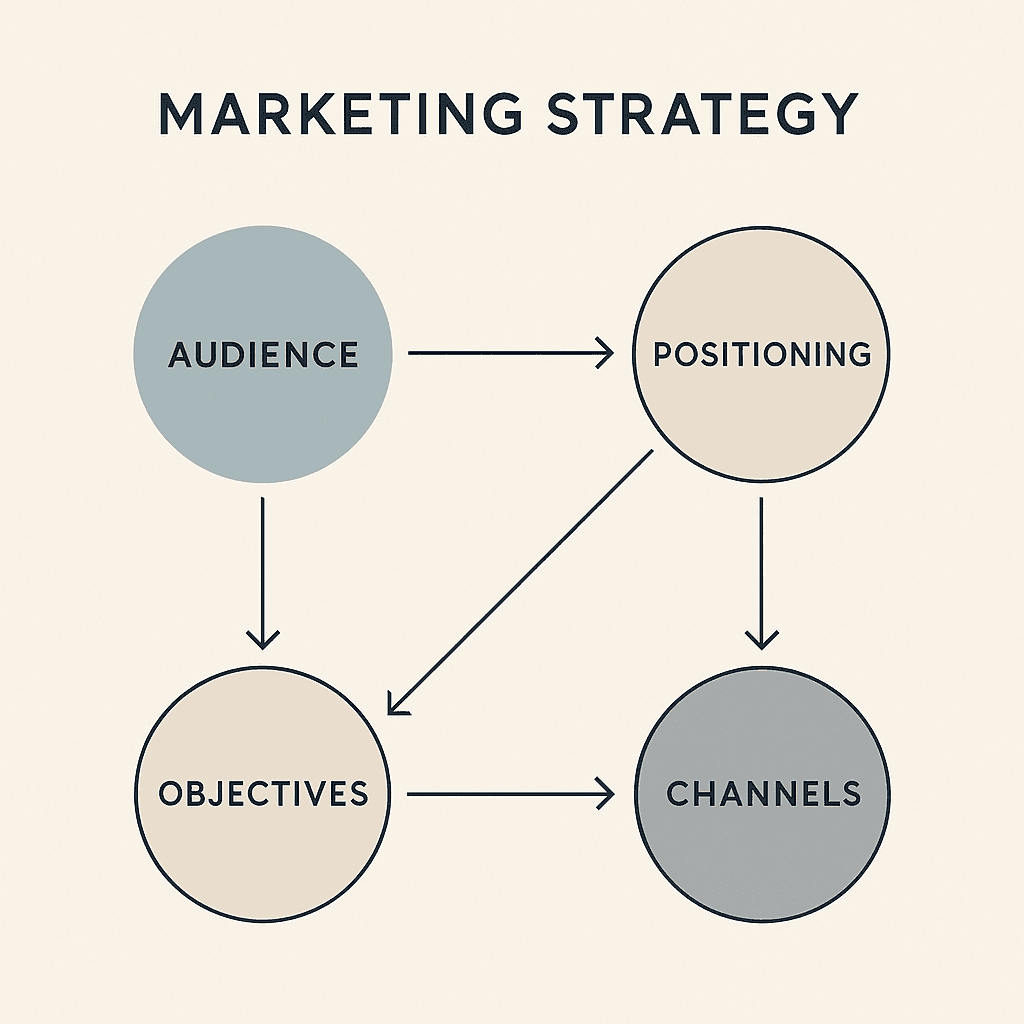
A strong marketing strategy answers five essential questions:
Who is the ideal customer?
What problem matters most to them?
Why should they trust this brand?
Where should the brand show up?
How will success be measured in business terms?
If these answers are unclear, execution will be fragmented.
Why Strategy Separates Growth From Noise
Strategy Eliminates Reactive Marketing
Organizations without a clear strategy tend to react to competitors, trends, and internal pressure. Channels are added without rationale, campaigns are launched without alignment, and priorities shift constantly.
High-performing teams take the opposite approach. They reduce activity to increase impact.
Several B2B SaaS companies have scaled revenue by narrowing their focus—prioritizing SEO and mid-funnel educational content after identifying that most closed deals engaged with this material before converting. Growth came not from doing more, but from doing less, better.
Strategy Aligns Marketing With Revenue
Marketing becomes a growth driver only when it aligns tightly with business objectives.
HubSpot’s early success illustrates this clearly. Content was not produced for visibility alone; it was designed to answer buyer questions at each stage of the funnel. Blog content fueled email growth, email drove adoption of free tools, and free tools accelerated product usage. Each component reinforced the next.
This is a strategy as a system—not a collection of campaigns.
Strategy Redefines Measurement
Without a strategy, teams measure what is easy: impressions, clicks, and engagement.
With strategy in mind, measurement focuses on outcomes: qualified leads, conversion rates, acquisition costs, retention, and lifetime value.
Netflix does not evaluate content performance by views alone. Completion rates and retention impact matter more. Marketing teams that adopt this mindset move from reporting activity to improving performance.
Core Pillars of an Effective Marketing Strategy
Market Research: Insight Before Execution
Strong strategies begin with understanding—not assumptions.
When Airbnb expanded beyond budget travel, deep qualitative research revealed that customers valued experience and belonging as much as price. This insight led to a fundamental shift in messaging and positioning, reshaping the brand globally.
Market research should clarify:
Purchase triggers
Key objections
Competitive alternatives
Without this insight, messaging lacks relevance.
Target Audience: Specificity Wins
Broad targeting leads to generic messaging.
Slack achieved early growth by focusing narrowly on fast-moving teams frustrated with email. That clarity enabled organic adoption and strong word-of-mouth momentum.
Precision improves relevance, conversion, and efficiency.
Unique Selling Proposition: A Strategic Filter
A USP is not a tagline—it is a strategic anchor.
Allbirds’ focus on sustainability and comfort influenced product design, partnerships, and messaging. A well-defined USP simplifies decision-making across marketing, product, and brand.
The core question remains: Why choose this brand over the next best option?
Channel Strategy: Focus Over Presence
Every channel decision is a strategic bet.
LinkedIn is critical for B2B authority. TikTok excels for brands that communicate visually and emotionally. SEO rewards patience and intent-based discovery.
Strong strategies do not attempt to win everywhere. They invest where audience behavior and business goals intersect.
Budget Allocation: Discipline Enables Scale
A common mistake is spreading the budget evenly “to test everything.
Experienced teams prioritize proven channels and allocate a limited budget to experimentation. A widely adopted framework:
70% on proven channels
20% on emerging opportunities
10% on experiments
This balance protects performance while enabling learning.
Measurement and Optimization: Strategy Is Iterative
Strategy is not static.
Organizations like Amazon continuously test messaging, layouts, and offers, understanding that minor improvements compound over time. Marketing strategies must evolve through constant measurement and refinement.
Digital Marketing as Strategic Infrastructure
Digital channels dominate modern marketing because they are measurable and adaptable.
SEO builds long-term demand.
Content establishes trust.
Paid media accelerates testing.
Email sustains relationships.
The most effective strategies integrate these channels into a cohesive system rather than operating them in silos.
Proven Strategies Used by High-Performing Teams
Rather than listing tactics, successful teams focus on intent:
Content reduces friction before sales conversations
SEO captures high-intent demand
Social builds familiarity and credibility
Influencers transfer trust
Email drives owned engagement
PPC accelerates learning
Webinars exchange value before commitment
Testimonials reduce risk
Retargeting reinforces relevance
Local SEO captures proximity-based intent
Video increases retention
Referrals scale trust
Communities build loyalty
Mobile optimization removes friction
Analytics enable informed decisions
Not every strategy is required. Only the right combination matters.
A Practical Framework for Building a Marketing Strategy
Define clear business objectives
Understand the market and audience deeply
Articulate a differentiated USP
Select channels intentionally
Allocate budget with discipline
Measure outcomes, not activity
Revisit the strategy regularly
Final Perspective
Effective marketing strategies are built through clarity, focus, and informed trade-offs. They prioritize long-term growth over short-term noise and align teams around outcomes that matter.
Marketing strategy is not about doing more.
It is about doing what matters—with consistency and intent.
Talent that changes the game
You’ve built momentum. Now add the talent that helps you scale it.